In British Columbia, the standard tool for setting up a secure construction framework is a CCDC contract, which is selected, customized, and administered by the project’s prime engineering consultant. Knowing how these standardized agreements work is key to managing financial risk, ensuring strong workmanship, and keeping projects moving on schedule.
For WCP Building Renewal, aligning our construction execution with the engineer’s contract framework is the foundation every project plan is built on, well before the first scaffold goes up.
In the Vancouver Lower Mainland, overseeing significant renovation projects for commercial buildings or residential strata complexes presents a unique set of difficulties. Strata councils, building owners, and property managers must balance limited capital expenditures with the reality of the local climate. Resilient building renewal solutions are necessary in our area because of the high yearly rainfall, continuous seismic danger, and coastal salt-air corrosion that accelerates concrete deterioration.
What Are CCDC Contracts?
A CCDC contract is a standardized, consensus-built construction agreement created by the Canadian Construction Documents Committee. Architects, engineers, contractors, and public and private owners are all fairly represented on this national joint committee.
These templates avoid using language that favors one party over another since they are created by a committee that represents all sides of a project. Rather, from the first day of site mobilization, they provide a solid, widely accepted foundation for assigning risk, protecting capital reserve funds, and establishing unambiguous accountability.
These documents are already recognized by engineering firms, banks, insurers, and strata lawyers throughout British Columbia, which facilitates swift discussions about finance, insurance, and bonding. While your project engineer or consultant will select, draft, and administer the specific CCDC document, our team ensures total compliance with its financial, scheduling, and operational rules, making the restoration process seamless for both the strata council and the engineering team.
Technical Application in the Vancouver Lower Mainland
In British Columbia’s coastal climate, regional factors, chiefly the structural water ingress tied to our “Rain City” conditions, shape how building restoration contractors execute and comply with project contracts administered by engineering consultants. Aligning the correct construction execution model with the engineer’s contract framework protects both the asset owner and the renewal project’s bottom line.
High-Rise Building Enclosure Renewal: CCDC 2 (Stipulated Price Contract)
These documents are already recognized by engineering firms, banks, insurers, and strata lawyers throughout British Columbia, which facilitates swift discussions about finance, insurance, and bonding. That said, the Lower Mainland’s long history of moisture intrusion means hidden damage is always a possibility.
If our crew strips away a failing membrane and finds extensive hidden wood rot or structural framing decay behind a wall assembly from long-term water ingress, that’s a classic “unforeseen site condition.” Under standard CCDC 2 terms, discovering deficiencies like this triggers a formal Change Order process administered by the engineer. WCP Building Renewal submits a detailed scope and cost proposal for the additional remediation work, which the engineer independently reviews and certifies before authorizing us to proceed with structural repairs ahead of installing the new rainscreen and membrane systems.
Parkade Structure Rehabilitation: CCDC 4 (Unit Price Contract)
In the Vancouver Lower Mainland, older concrete parkades frequently experience widespread spalling due to exposure to coastal air and chloride intrusion from de-icing solutions. This is exacerbated by carbonation, which gradually erodes the alkaline coating surrounding structural rebar. A fixed-price contract approach poses significant financial risk for both the owner and the contractor because it is practically impossible to determine the actual level of delaminated concrete and damaged rebar once corrosion takes hold without expensive, destructive testing.
A CCDC 4 (Unit Price Contract) is better suited to these conditions. Rather than forcing both parties to guess at repair volumes upfront, the engineer establishes fixed unit prices, for example, a set rate per square meter of concrete removal and replacement, and a separate rate per linear meter of rebar treatment or replacement. The owner only pays for the volume of work actually completed, eliminating the need for inflated contingency allowances built into a lump sum price.
As the executing contractor, WCP Building Renewal tracks and documents all measured quantities on-site as work progresses. The engineer independently verifies those quantities before certifying each progress payment, giving the owner a fully auditable record of exactly what was repaired, where, and what was paid, with no ambiguity at project close.
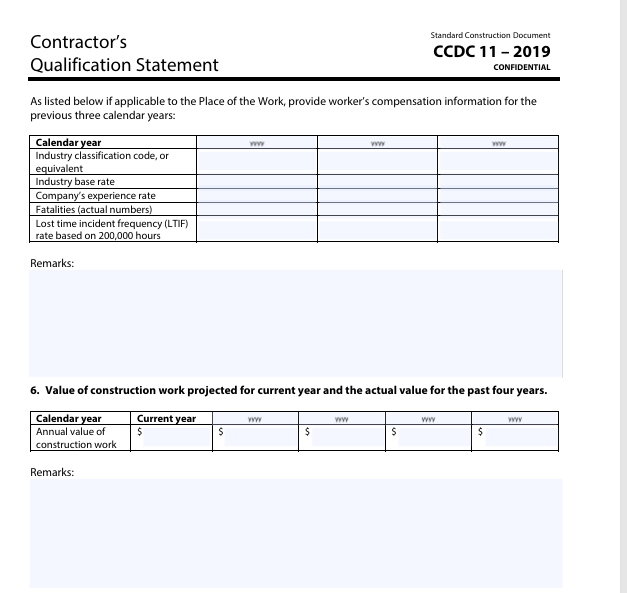
Vendor Prequalification: CCDC 11 (Contractor’s Qualification Statement)
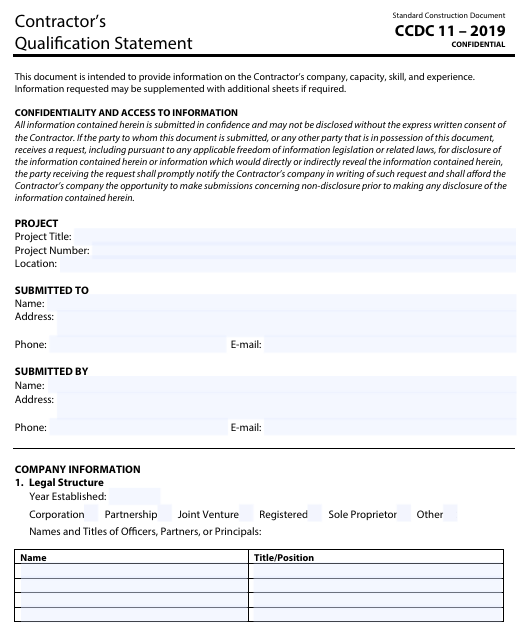
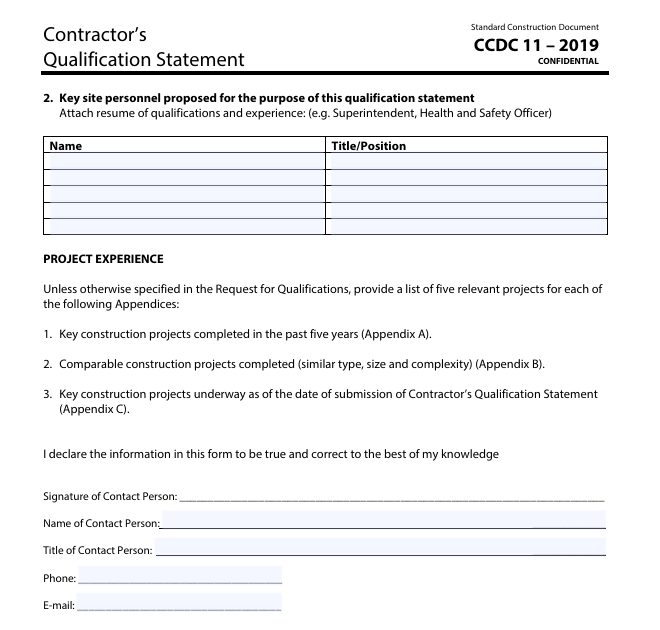
Before a contract is awarded, building engineers use the CCDC 11 to vet a restoration contractor’s financial stability, safety record, and structural capability. The CCDC 11 framework provides a transparent snapshot of a contractor’s corporate health by explicitly auditing:
- Financial & Bonding Capacity: Verification of corporate liability insurance limits, bank references, and surety bonding thresholds.
- Personnel Expertise: The specific technical qualifications and past project history of the superintendents and project managers assigned to the job.
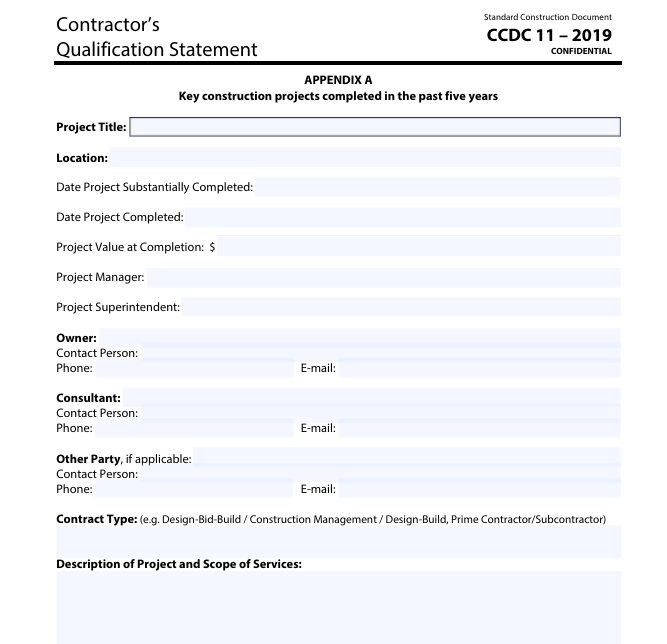
- Track Record: A certified list of comparable building renewals completed over the past five years, alongside active project backlogs to confirm operational bandwidth.
- Safety Compliance: Health and safety policies, risk mitigation protocols, and an active WorkSafeBC clearance standing.
For WCP Building Renewal, a transparent CCDC 11 submission is standard practice. It allows the administering building engineer to objectively verify that our team possesses the specialized resources and regional experience required to successfully execute the project before the strata council makes a financial commitment.
The Most Common CCDC Contract Types for Building Renewal
Not every renewal project is structured the same way. A predictable exterior sealant replacement program calls for a different contractual approach than a complex, multi-phase concrete repair project where the true extent of subsurface damage stays unknown until demolition starts.
Picking the right CCDC contract template comes down to the project delivery model selected by the engineer, how scopes are defined, and how risk gets distributed.
The table below matches specific building renewal challenges to the ideal consensus-based document framework.
CCDC Contract Comparison for Building Renewal Projects
| Contract Type / Statement | Official Name | Best Used For in Building Renewal | Core Risk Allocation / Primary Purpose |
| CCDC 2 | Stipulated Price Contract | Highly predictable, fully designed scopes (e.g., multi-family window or roof replacements). | Fixed Lump Sum: Contractor absorbs productivity risks; owner absorbs unexpected structural discoveries. |
| CCDC 3 | Cost Plus Contract | Complex restorations where the scope cannot be defined upfront (e.g., severe high-rise exterior degradation). | Cost + Fee: Owner assumes financial risk for actual hours/materials but retains high flexibility. |
| CCDC 4 | Unit Price Contract | Parkade concrete spalling, rebar remediation, or deep envelope water ingress repairs. | Pay-by-Volume: Fixed price per unit of measurement (e.g., per square meter of concrete). The owner only pays for the exact volume replaced. |
| CCDC 5A | Construction Management Contract – For Services | Multi-million dollar capital portfolios needing early contractor expertise and engineering coordination. | Owner-Direct Trade Risk: CM acts purely as an advisor. Owner signs separate, direct trade contracts. |
| CCDC 5B | Construction Management Contract – For Services and Construction | Fast-tracked asset renewals or comprehensive commercial tenant/common area upgrades. | Dual Phase: CM advises during planning, then transitions to execute construction, managing sub-trades directly. |
| CCDC 11 | Contractor’s Qualification Statement | Vetting and pre-qualifying restoration contractors during the procurement or RFQ process led by the building engineer. | Vetting Baseline: Standardized verification of contractor capacity, financial health, safety records, and past structural project history prior to contract award. |
| CCDC 14 | Design-Build Stipulated Price Contract | Turnkey retrofits and mechanical overhauls where a single entity should own both design and construction. | Single Point of Contact: One entity handles both engineering/design and construction, reducing internal friction. |
How WCP Building Renewal Partners with Engineers on CCDC Projects: A Step-by-Step Compliance Framework
For a building restoration specialist, working under a standardized CCDC contract means maintaining disciplined compliance with the project building engineer framework. When working with strata councils, commercial asset managers, and building engineers across the Lower Mainland, WCP Building Renewal aligns workflows with the consultant’s execution strategy:
Step 1: Aligning with the Engineer’s Delivery Model
Before a single tool arrives on-site, WCP Building Renewal coordinates with the project’s prime consultant or building engineer to align our operational plan with their chosen delivery method. If the building engineer has already drafted complete construction drawings and specifications for a straightforward scope, like a multi-family townhome window and siding replacement, a traditional design-bid-build model using a CCDC 2 (Stipulated Price) keeps costs fixed and predictable. For complex projects with significant structural unknowns, we adapt our tracking to the consultant’s CCDC 4 (Unit Price) or hybrid model.
Step 2: Cooperating with Copyright Seal Requirements
CCDC documents are protected legal forms copyrighted by the Canadian Construction Documents Committee. To maintain document integrity and full legal compliance, WCP Building Renewal cooperates with the administering consultant to ensure all executed contract forms carry an official, serialized copyright seal obtained through approved local distributors, such as the BC Construction Association (BCCA). Operating without these seals is a serious breach of copyright licensing that can compromise the contract and jeopardize dispute resolution.
Step 3: Reviewing Custom Supplementary Conditions
Standard CCDC agreements are deliberately generic so they can apply across any Canadian province or sector. They don’t automatically account for the strict administrative rules of a BC residential strata, dense municipal bylaws, or unique coastal environmental risks. WCP Building Renewal thoroughly reviews and adheres to the custom Supplementary Conditions integrated by the owner’s legal counsel and building envelope engineers. These addendums adjust the standard text to spell out local realities like specialized insurance limits, restricted strata access hours, multi-unit site safety mandates, and strict progressive payment protocols.
Step 4: Adhering to Regional Regulatory Alignments
Our project execution framework is built to mirror regional requirements seamlessly. We ensure all on-site restoration work and materials align with the consultant’s parameters regarding:
- BC Housing Guidelines: Following strict licensing requirements, owner-builder provisions, and building envelope technical bulletins.
- Engineers and Geoscientists BC (EGBC): Accommodating required field reviews and professional assurance obligations where applicable.
- CleanBC Pathways: Providing the required material submittals and reporting for insulation upgrades or high-performance thermal breaks so clients capture the documentation needed to secure commercial or multi-family energy efficiency incentives.
- Local Energy & Carbon Bylaw Alignments: Depending on the exact municipality in the Lower Mainland (e.g., Vancouver, Burnaby, Richmond), major building enclosure renewals, especially those altering the building envelope or mechanical systems, must comply with strict local energy upgrade bylaws, greenhouse gas intensity limits, or local adaptations targeting existing building alterations. Our team ensures all retrofits seamlessly transition to meet these municipal carbon-reduction and performance targets.
Step 5: Incorporating BC Statutory Timelines and Modern Milestones
The closing phases of an active building restoration project carry the highest legal exposure for property managers and strata councils regarding liens, holdbacks, and liability transfers. WCP Building Renewal mitigates this risk by executing closeouts under the strict oversight of the building engineer, utilizing the standardized dual-milestone structure:
- Substantial Completion: The BC Builders Lien Act is strictly followed in the management of this milestone. Although a Certificate of Substantial Completion gives suppliers or subcontractors 45 days to register a lien, Section 8 of the Act stipulates that the 10% statutory holdback must be kept for the entire 55 days following the date of the certificate’s issuance. A lien filed electronically at the very end of the 45-day window will have time to appear on a title search thanks to the required 10-day gap between the lien-filing deadline and the holdback release, which accommodates registry processing periods at the Land Title Office. Waiting out the full 55 days and running a clear title search is the mandatory protocol a strata council must follow before legally releasing holdback funds.
- Ready-for-Takeover: Reaching Ready-for-Takeover represents a critical legal handoff: it officially transfers care, custody, and building insurance responsibilities back to the strata corporation or asset owner. Additionally, it establishes the definitive, contractually mandated start date for the baseline one-year workmanship correction and warranty period.
Mitigating Risk in Multi-Unit and Commercial Assets
Running a building renewal project on a high-rise condominium, active warehouse, or occupied office building is inherently disruptive. Our restoration crews carry out heavy structural repair, grinding concrete, or replacing building skins around active tenants, businesses, and residents.
WCP Building Renewal treats the CCDC contract administered by the engineer as an active risk-management tool. The matrix below shows how common renewal risks are allocated and managed using standard CCDC clauses paired with targeted, localized supplementary conditions.
Risk Mitigation Strategy Matrix
| Project Challenge | What the Standard Contract (CCDC) Says | Operational Alignment / Compliant Execution |
| Hidden Site Damage (e.g., finding rotten wood behind walls once work starts) | Unforeseen Site Conditions: For a contractor to successfully claim a Change Order, they must prove the conditions differ materially from the Contract Documents. | Test Early / Hybrid Structure: We recommend engineers use thermal imaging or cut small “test holes” before finalizing pricing. We work seamlessly with defined Schedules of Unit Prices to handle remediation transparently. |
| Bad Weather Delays (e.g., heavy rain stops outdoor sealant application) | Weather Delays: The contractor gets extra time if “abnormally bad” weather causes delays outside of their control. | Follow Engineering Specifications: We align tracking with local weather data definitions. Clearly execute requirements for protective tarps or scaffolding wraps as directed by the consultant. |
| Tenant & Resident Disruption (e.g., loud noise, blocked parking) | Control of Means and Methods: The contractor has full control over how they run the site, schedule the work, and manage safety. | Respect Strata Bylaws: We strictly abide by locked-in working hours (e.g., 8 AM–5 PM), provide 72 hours’ notice before entering balconies, and coordinate loud drilling for mid-day. |
| Bad or Faulty Work (e.g., a new waterproof coating leaks) | Warranty Period: The contractor must correct defects or work that fails to match specifications for 1 year starting from Ready-for-Takeover. | Deliver Premium Craftsmanship: We stand by our work and easily accommodate extended warranties (5 to 10 years) requested by engineers on critical roofing/waterproofing items, facilitating manufacturer sign-offs. |
| Money Disputes & Liens (e.g., a subcontractor files a claim over unpaid bills) | Monthly Progress Payment Process: The contractor gets paid monthly based on how much work the building consultant verifies is actually done. | Provide Total Financial Transparency: We provide a signed legal document (Statutory Declaration) each month proving we have fully paid all workers, sub-trades, and material suppliers. |
The Role of the Payment Certifier: Independent Quality Assurance
A successful building renewal project depends on a clear system of checks and balances. Within the CCDC contract structure, this falls to the designated Project Consultant, who acts as the third-party Payment Certifier. In British Columbia’s restoration sector, this role typically goes to a professional building science engineer, a building envelope specialist, or an architect.
The Consultant serves as an impartial contract administrator between the asset owner (or strata council) and the WCP Building Renewal project management team. They don’t automatically side with either party; instead, they interpret the contract documents objectively to make sure both sides meet their obligations.
Who Qualifies as an Independent Payment Certifier?
To keep job sites fully impartial, the Payment Certifier must be a genuinely independent third party with no contractual ties to WCP Building Renewal as the restoration contractor. They’re typically one of the following:
- A Building Envelope Engineer retained directly by the strata council or property manager.
- A Professional Engineer (P.Eng.) specializing in structural restoration or building enclosure performance.
- A Registered Architect (AIBC) with deep expertise in modern building science.
- A Specialized Building Science Consultant overseeing localized envelope renewals.
Field Reviews and Progress Billing
Rather than treating third-party oversight as a hurdle, WCP Building Renewal welcomes the accountability an independent Consultant brings to the project. This collaborative process ensures quality and financial clarity through two key steps:
- Objective Quality Control: The Consultant conducts regular, scheduled field reviews of our work, whether we are applying a multi-layer elastomeric traffic membrane in a parkade or installing a modern rainscreen assembly on a high-rise. This confirms that our craftsmanship matches the engineering specifications before it’s covered by subsequent building layers.
- Transparent Financial Valuation: When our project manager submits a monthly progress claim, the Consultant reviews the completed work on-site to verify quantities and accuracy. Only after this independent verification do they issue an official Certificate for Payment.
Frequently Asked Questions
Q1: Can a strata write its own construction contract instead of using a CCDC framework? A: Technically, yes, but it’s not advisable. Custom “homegrown” contracts often contain legal loopholes, unfair risk shifting, or vague language that leads to litigation. CCDC agreements administered by an engineer are trusted industry standards that banks, insurers, and subcontractors already recognize, which speeds up project timelines significantly.
Q2: What is a “Supplementary Condition” in a CCDC contract?
A: Standard CCDC agreements are deliberately generic to fit all of Canada. Supplementary Conditions are customized amendments added to the contract by the building engineer or legal counsel to modify or add specific clauses like localized tax rules, restricted access hours, or site safety mandates without rewriting the entire standard text.
Q3: Does a CCDC contract protect the owner or the contractor more?
A: Neither. The Canadian Construction Documents Committee’s entire mandate is to maintain strict neutrality and consensus. CCDC contracts aim for balanced risk allocation by assigning responsibilities to whichever party is best positioned to manage them under the building engineer’s supervision.
Q4: What happens if a dispute arises during a CCDC-governed project?
A: CCDC contracts include built-in dispute resolution frameworks that typically start with negotiation and mitigation overseen by the Consultant. Depending on the contract terms and supplementary conditions, unresolved disputes may then move to mediation, arbitration, or litigation.
Q5: What is the difference between “Substantial Completion” and “Ready-for-Takeover” in British Columbia?
A: These milestones mark the difference between when a project is sufficiently complete for its intended use and when all contractual obligations are fully satisfied.
- Substantial Completion: This occurs when the project is ready for its intended use and meets the legislative requirements of the BC Builders Lien Act. While the contract engineer certifies Substantial Performance to trigger the 45-day lien-filing period for subcontractors, Section 8 of the Act strictly mandates that the 10% statutory holdback must be retained for a full 55 days from the certificate’s issuance date. This statutory 10-day gap ensures that any lien filed electronically at the absolute end of the 45-day window has sufficient time to clear registry processing and surface on a Land Title Office search. Waiting out the full 55 days and executing a clean title search is a mandatory risk-mitigation protocol that a Strata Council must follow before releasing holdback funds.
- Ready-for-Takeover: This is the contractual milestone under modern CCDC frameworks marking the complete fulfillment of all contractor obligations, the resolution of minor punch-list items, and the official handover of care, custody, and building insurance responsibilities back to the owner. It also marks the definitive start of the baseline one-year workmanship warranty period.
Q6: What is the “Consultant” role in a CCDC contract, and why does it matter? A: In CCDC contracts, the Consultant (usually an architect or building engineer) acts as an independent, neutral third party, even though the owner retains them. They interpret contract documents, judge quality, and certify payments. They conduct regular field reviews on-site to inspect critical stages of construction before those layers are covered up.
Q7: How do CCDC frameworks handle unexpected delays, like bad weather or supply chain issues? A: It depends on the cause. If it’s something entirely outside the contractor’s control, like severe weather or strikes, the contract framework typically grants extra time but not extra money. If the owner or consultant causes the delay (e.g., late design changes), the contractor is granted both extra time and compensation for added costs.
Q8: What is a “Change Order” vs. a “Change Directive” used under CCDC contracts? A: Both modify the original contract work, but they differ in authorization:
- Change Order: A mutual agreement. The owner, building engineer, and contractor agree upfront on what the change is, how much it costs, and how much time it adds.
- Change Directive: A “do it now, settle the price later” order. If a change is urgent but the parties cannot immediately agree on cost, the owner (through the building engineer) can issue a directive forcing the contractor to proceed immediately so the project doesn’t stall. The final cost gets settled later through a set formula or dispute resolution.
Q9: Will using a CCDC contract framework slow down my strata’s project approval process?
A: It typically speeds things up. Because lenders, insurers, and building engineer consultants already recognize CCDC language, strata councils spend less time having custom legal terms reviewed and more time focused on scope, budget, and scheduling decisions that actually move the project forward.
Q10: Does WCP Building Renewal provide or draft CCDC contracts?
A: No. CCDC contracts are legal documents typically provided, customized, and administered by your independent Project Consultant or Building Science Engineer. WCP Building Renewal acts strictly as the restoration contractor executing the physical work. We support the planning phase by providing highly accurate cost estimates, technical logic, and scheduling data so that the building engineer can seamlessly integrate our operational realities into their CCDC framework.
Q11: Where would you use a CCDC-11 Document?
A: The CCDC 11 – Contractor’s Qualification Statement is typically used in the pre-qualification phase of procurement. This framework helps owners and building engineers identify and evaluate potential contractors before inviting them to bid on large or complex projects. The contractor fills out the document to provide formal verification of their corporate capacity, historical performance, specialized skills, and financial capability.
What to Expect When You Work with WCP Building Renewal
The engineer or building science consultant is the one who selects the appropriate CCDC contract type, drafts it, customizes the supplementary conditions, and administers it throughout the project. They serve as the contract administrator certifying payments, issuing change orders, conducting field reviews, and signing off on milestones.
The building restoration contractor, like WCP Building Renewal, signs the CCDC contract and is legally bound by it to execute the physical work in absolute compliance with the framework established by the engineer.
Our Phased Execution Process
When partnering with WCP Building Renewal, your renewal project follows a disciplined, professional lifecycle:
- Pre-Building Restoration Meeting: WCP Building Renewal, the Consultant, and the strata council or property manager confirm site logistics, access restrictions, emergency contacts, and communication protocols before mobilization.
- Monthly Progress Draws: WCP Building Renewal submits a detailed application for payment to the building engineer, supported by measured quantities, photographic proof, and a signed Statutory Declaration confirming that all sub-trades, labor, and material suppliers have been paid in full.
- Field Reviews: The Consultant inspects critical-stage restoration work such as membrane laps, rainscreen cavities, or concrete placement.
- Change Management: Any deviation from the original design scope caused by hidden deficiencies is processed transparently through the building engineer via a formal Change Order or Change Directive, ensuring cost and schedule impacts are tightly monitored.
- Closeout: Substantial Performance and Ready-for-Takeover are certified sequentially by the building engineer. Holdback release timelines are strictly tracked against the BC Builders Lien Act, and all operations, maintenance, and warranty documentation is turned over cleanly to the owner.
Why Strata Councils & Property Managers Choose WCP
Strata Governance Expertise
We build project timelines around the BC Strata Property Act voting thresholds, so administration never stalls building renewal.
- Contingency Reserve Fund (CRF): If the building renewal is being funded entirely from the CRF, it typically requires a majority vote at a general meeting.
- Special Levy: If the renewal requires a special levy (as is common with large window, siding, or parkade projects), it strictly requires a 3/4 majority vote under the Strata Property Act.
Climate-Aware Scheduling
The Lower Mainland’s wet weather leaves a narrow window for moisture-sensitive coatings and membranes. We phase these scopes upfront to avoid mid-project delay claims.
Engineer-Verified Transparency
Every dollar spent is independently reviewed and certified by your project engineer before payment is issued, giving you full visibility into the budget.
Fully Licensed, Bonded & Insured
Every project is backed by comprehensive liability insurance, robust surety bonding, and full WorkSafeBC compliance.
Contact WCP Building Renewal
WCP Building Renewal specializes in efficient project management, building inspection, and restoration across the Vancouver Lower Mainland. Whether you’re a strata council planning an envelope renewal, a property manager facing parkade deterioration, or a commercial asset owner preparing for a capital project, our team can walk you through the right CCDC contract structure for your scope. Reach us at [email protected] or by phone at 604.420.5552.