Recruitment specialist Nik Gandhorkia from Foresight Recruitment Group joins WCP’s new Building Better podcast series to explore property management and talent challenges and the shifting industry demands and what it takes to build stronger teams.
The property management industry is evolving, and so are the demands placed on the people who work to keep buildings and properties operating at their best. Factors ranging from an aging workforce and widening skill gaps to increasingly complex capital projects and even global energy and supply issues mean property managers face an expanding range of responsibilities, many of which call for fresh perspectives, new skills and more strategic approaches to team member recruitment.
In our new podcast series, Building Better, host Steven Bailey sits down with industry professionals to explore some of the challenges, opportunities and trends that are shaping the property management, construction and maintenance environments.
In this first episode, Steven speaks with Nik Gandhorkia, co-founder of Foresight Recruitment Group and an experienced real estate recruitment specialist, about the changing recruitment landscape, the expanding role of property managers and what organizations can do to attract, develop and retain the talent they need.
Hear the full conversation with Nik Gandhorkia – watch Episode 1 of Building Better on YouTube.
Meet Nik Gandhorkia: A Fresh Perspective on Recruitment
With more than a decade of recruitment experience across Canada and the UK, Nik Gandhorkia brings a broad perspective on the challenges of attracting and retaining quality talent. His career has spanned multiple industries, including real estate, architecture, engineering and finance, giving him firsthand expertise and insights into the changing demands of both employers and job seekers.
In 2024, Nik co-founded Foresight Recruitment Group with business partner David Little, bringing together the structured recruitment practices he worked to develop at firms such as Hays and Adecco with a proven personal, relationship-driven approach.
For Nik, successful recruitment goes beyond just filling positions. It’s about understanding people, building genuine relationships and creating reliable workplace cultures where individuals can thrive.
The changing landscape of property management in BC and beyond
Canada’s property management industry is facing a convergence of challenges, from an aging workforce and growing skills shortages to increasingly complex building operations. As experienced professionals approach retirement, the industry faces the prospect of losing decades of institutional knowledge at a time when demand for skilled property and building managers remains strong.
Nik points to the current shortage of mid-career professionals who have the experience needed to step into more senior roles. This creates challenges for employers looking to replace retiring staff, maintain operational continuity and develop the next generation of industry leaders.
“The overarching challenge we’re seeing across Canada, regardless of the market, whether it’s in property management or building operations, is the fact that it is an aging workforce,” Nik explains.
At the same time, the responsibilities property managers are having to take on continue to expand. Beyond day-to-day building operations and tenant relations, many are now expected to oversee capital improvements, coordinate major construction and repair projects, and navigate evolving sustainability requirements.
Unlike some sectors, property management remains essential through periods of economic uncertainty. Buildings will always continue to require ongoing maintenance, repairs and capital investment regardless of market conditions. For employers in the industry, the challenge is finding and developing professionals with the technical knowledge, leadership skills and adaptability to meet these changing demands.
Trends in the Aging Workforce- Nik Gandhorkia – Foresight Recruitment
How and why recruitment challenges vary across Canada
While property management companies across Canada may face similar workforce challenges, finding and retaining qualified professionals often comes down to local market conditions. Geography, home prices, commuting patterns, economic activity and the availability of experienced candidates can all influence recruitment decisions.
Drawing on his experience in markets across the country, Nik emphasizes the importance of understanding these regional differences. In Metro Vancouver, for example, commuting challenges between the North Shore and other parts of the region can influence where candidates are willing to work. Meanwhile, continued development in communities such as Surrey and Langley is creating opportunities beyond Vancouver’s traditional employment centres.
Similar considerations apply elsewhere in Canada. In Ottawa, commuting distances between communities such as Kanata and Orléans can affect candidate preferences, while smaller markets in Atlantic Canada face different challenges related to the availability of specialized talent.
For employers, these differences highlight the limitations of a one-size-fits-all recruitment strategy. Understanding local labour markets, candidate expectations and regional employment patterns can help property management companies attract qualified professionals and make more informed hiring decisions.
Role of Property Managers – Nik Gandhorkia – Foresight Recruitment
Regional factors influencing property management recruitment
| Region | Recruitment Influences |
| Metro Vancouver | Commuting challenges, particularly to and from the North Shore, and growing employment opportunities in Surrey and Langley |
| Alberta | Market-specific economic conditions and local talent availability |
| Ottawa | Geographic distances and commuting preferences between established employment centres |
| Atlantic Canada | Smaller candidate pools and access to specialized professionals |
The evolving role of property managers
From HVAC replacements and energy retrofits to extensive building renewal projects, these initiatives require a combination of technical understanding, financial oversight and effective communication skills.
The responsibilities of property managers increasingly extend beyond day-to-day building operations, tenant relations and routine maintenance. Today, many are also expected to coordinate major capital improvement projects, oversee contractors and manage complex relationships between property owners, tenants and service providers.
As Nik explains, growing investment in building improvements has placed all-new demands on the roles of property managers:
“A lot of that responsibility then falls onto the property managers who now, in turn, turn into your project managers.”
With property managers often serving as the central point of contact, their ability to coordinate stakeholders, establish clear communication channels and manage competing priorities has become increasingly important.
Yet, as Nik observes, not all property managers have formal project management training, despite being expected to take on these responsibilities. Professionals who pursue additional education, gain hands-on experience or obtain credentials such as Project Management Professional (PMP) certification can be better equipped to oversee increasingly complex projects.
Clear decision-making authority and well-defined responsibilities are equally important. By aligning expectations early and maintaining effective communication between owners, contractors and tenants, property managers can help minimize disruptions and keep capital improvement projects moving forward.
Building stronger teams through more strategic hiring
Finding the right qualified professionals is only part of the recruitment challenge. For property management companies, knowing when to hire and being able to clearly define what a new employee is expected to accomplish within a certain timeframe can be just as important.
Nik emphasizes the value of intentional hiring: looking beyond an immediate vacancy to consider the organization’s longer-term goals. Whether a company needs someone to maintain existing operations, oversee new capital improvements or lead organizational change, establishing expectations from the outset can help attract the candidates with the right experience and capabilities.
Timing is particularly important when recruiting for major building renewal and capital improvement projects. Nik recommends bringing key personnel on board as much as 6 to 18 months in advance, depending on the project’s scope and complexity. Early involvement gives new hires an opportunity to understand project objectives, contribute to strategic decisions and take ownership of the work ahead. Hiring too late can lead to rushed transitions, misunderstandings, communication gaps and unnecessary frustrations.
Strategic workforce planning also means looking beyond individual projects. By anticipating future staffing needs, developing internal talent and preparing for the eventual retirement of experienced employees, property management companies can reduce their reliance on reactive hiring while building more capable, resilient teams.
Request a Free Consultation
How AI is changing recruitment: Balancing human judgment with technology
From screening applicants and applications to automating time- consuming administrative tasks, artificial intelligence is rapidly changing the way organizations identify, evaluate, and successfully secure new talent. The goal, in this industry as in others being altered by this powerful technology, is to help recruitment teams work more efficiently and devote more time and resources to higher-value activities.
However, as Nik emphasizes in the podcast, the technology still has its limitations, particularly when recruiting for specialized roles in property management and building operations. Truly understanding a candidate’s motivations, assessing their suitability for a particular workplace, and convincing an experienced professional to consider a new opportunity are all skills that require a level of personal engagement that technology cannot (and likely should not) replicate.
For employers in the property management industry, successful recruitment involves more than matching a potential hire’s qualifications to a job description. It requires a deep understanding of organizational culture, career aspirations and the interpersonal skills needed to work effectively with tenants, contractors and property owners.
Nik sees value in embracing AI rather than resisting it—provided it complements human insight and experience rather than trying to replace it. By combining AI’s technological efficiency with genuine relationships and informed judgment, recruitment professionals can take advantage of new tools without losing the personal connections that remain central to successful hiring and successful work in the field.
The importance of employee retention and company culture in property management
Attracting high-calibre professionals to your organization is one challenge. Keeping them over the long-term, is another. After all, the process of acquiring and onboarding a skilled professional is an investment in itself. While competitive compensation and benefit packages matter, company culture, strong leadership, and meaningful opportunities for professional growth can be equally important in giving talented employees a reason to stay.
A critical component of building a strong workplace culture is undeniably authenticity. Drawing on his experience founding Foresight Recruitment Group, Nik notes that there was a conscious effort to create an environment where employees feel comfortable expressing themselves, sharing ideas and building genuine relationships. Rather than relying on rigid corporate structures, he advocates for a more personal approach to leadership built on openness, empathy and mutual trust.
These principles extend beyond individual organizations. Beyond the workplace, Nik emphasizes the importance of active involvement in professional associations and industry events to support career development, strengthen business relationships and create opportunities to exchange knowledge.
Through his participation in organizations such as BOMA, ICSC and the Canadian Real Estate Forum, as well as his leadership role with the BC Chapter Next Generation Committee, he has experienced firsthand the value of professional networking and industry engagement.
For property management companies, investing in their own workplace culture and professional development can help strengthen employee satisfaction, engagement and retention. Encouraging mentorship, supporting industry participation and creating opportunities for career advancement can also help organizations develop the next generation of property management leaders.
Key takeaways for property management companies and leaders
From workforce shortages, changing responsibilities and job definitions, to new technologies and evolving employee expectations, Canada’s property management industry faces a range of interconnected challenges. Throughout his conversation with Steven, Nik Gandhorkia emphasized the importance of forward-thinking recruitment, active professional development and building strong workplace relationships.
For property management companies looking to build capable, resilient teams, several practical strategies came out of the discussion.
| Industry Challenge | Recommended Approach |
| Aging Workforce | Develop clear succession plans, encourage mentorship and help facilitate the transfer of knowledge and skills between experienced employees and new hires |
| Shortage of experienced professionals | Proactive recruitment, investment in skills development and clearly established opportunities for career advancement |
| Ballooning & creeping property management responsibilities | Support project management training and provide employees opportunities to gain more experience with capital improvement projects |
| Industry competition for qualified talent | Offer competitive compensation packages in conjunction with a positive workplace culture, professional development and career opportunities |
| Capital project staffing issues | Plan recruitment well in advance and involve all key personnel in project planning and decision making |
| AI and recruitment technologies | Use AI for streamlining administrative processes, while maintaining human judgment and personal relations through the process |
Ultimately, Nik’s insights all point to a broader shift in how property management companies approach workforce planning. Instead of responding to staffing challenges case-by-case, organizations that anticipate future needs, invest in their people, and adapt to changing industry demands are better positioned for long-term success.
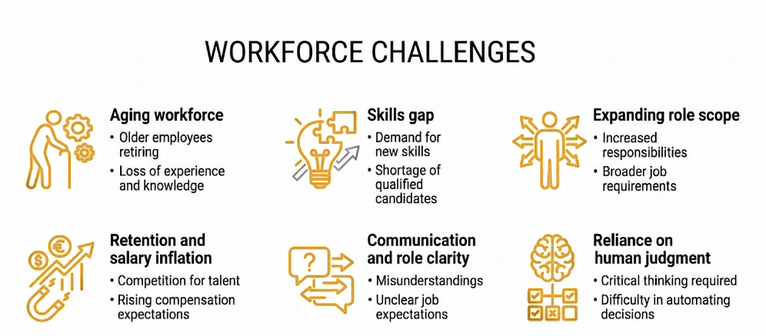
Workforce Challenges
Navigating today’s six core workforce challenges that are faced by organization nowadays.
FAQs about property management recruitment
1. What are the biggest recruitment challenges facing property management companies in Canada today?
Significant challenges to property management recruitment include an aging workforce, shortages of experienced mid-career professionals, and an increasing demand for specialized skills. As property management responsibilities expand, employers must also find candidates with the technical knowledge, project management capabilities and interpersonal skills needed to oversee increasingly complex building operations.
2. Why are project management skills becoming more important for property managers?
Property managers are increasingly responsible for coordinating capital improvement projects, building renovations and restoration projects, and major maintenance initiatives. These responsibilities all require effective budgeting, contractor coordination, stakeholder communication and organized project oversight. Strong project management training and hands-on experience can help property management professionals manage these additional demands.
3. How can property management companies address the issue of an aging workforce?
Succession planning, mentorship and ongoing professional development for younger or mid-career employees can all help organizations prepare for the retirement of more senior experienced employees. Encouraging knowledge transfer, developing emerging talent, and creating clear career advancement opportunities can also help preserve your institutional expertise and strengthen long-term stability of your workforce.
4. When should companies begin the recruiting process for major capital improvement projects?
Ideally, recruitment should begin well before a major project gets underway. Consider it a crucial first step of the project’s timeline. Depending on the scope and complexity of a project, recruitment specialist Nik Gandhorkia recommends bringing key personnel on board 6 to 18 months in advance. Early involvement allows new hires to fully understand project objectives, contribute to the planning process, and assume responsibility from the outset.
5. How is AI changing recruitment in the property management industry?
Artificial intelligence is helping recruitment teams streamline tasks such as application screening and administrative coordination. However, human judgment remains essential when assessing candidates, understanding workplace culture and building professional relationships. AI is most effective when used to support, rather than replace, experienced recruitment professionals.
6. What strategies can help property management companies attract and retain qualified employees?
Effective strategies include competitive compensation, clear career development opportunities, supportive leadership and a positive workplace culture. Proactive hiring, professional training and mentorship can help organizations attract qualified candidates while encouraging experienced employees to remain and grow within the company.
Building Better: Success through industry insights and collaboration
As the property management industry continues to evolve, conversations like these offer up valuable opportunities to share knowledge, challenge conventional ways of thinking, and explore new approaches to collective challenges.
Through our Building Better series, WCP Building Renewal brings together professionals from across the property management, construction and real estate sectors to share their experiences, perspectives and insights into the issues shaping the properties and places we manage.
At WCP, we understand the challenges property managers and building owners face in maintaining, improving and protecting their properties. From planning major capital improvements to navigating complex building renewal projects, our team works alongside clients to deliver practical, long-term solutions.
Stay tuned for more Building Better conversations with the industry professionals helping shape the future of our buildings and communities.
Have a building renewal project in mind?
Connect with WCP Building Renewal at [email protected] or 604-420-5552 to discuss your property’s needs.