What your BC depreciation report is really telling you. A clear guide to understanding and making the most of this important and necessary document.
Your strata’s depreciation report finally arrives. It’s a thick, technical, and important feeling document, but when the time comes to decide on major repairs, you’re still left wondering what to do with all the information it holds.
So, what is a Depreciation Report, and why does it matter?
In British Columbia, a depreciation report is typically required every 3 years under the Strata Property Act (though some councils may vote to defer this) to ensure strata corporations can properly plan for their building’s future.
A depreciation report in BC is usually prepared by qualified professionals like engineers or building science consultants with experience in building systems and capital cost planning. The strata will provide the consultant with the building documents, like previous reports, maintenance history, etc. From there, the consultant conducts their site review, making their observations and calculations in order to develop the report.
Once prepared, the report must be made available to the strata corporation, owners, and potential buyers.
At their core, depreciation reports are long-term planning tools designed to predict when major building components (like roofs, elevators, exterior cladding, and mechanical systems) might need repairs or replacement, and what those costs might look like over time.
They form a basis from which strata can reserve fund planning, and financially prepare for these expenses and other capital projects. Done properly, they support more stable and predictable fees to suite owners, fewer surprises, and better long-term decision making.
Examples of component repairs commonly referenced in a depreciation report:
- Roof repairs or replacement
- Building envelope work
- Window upgrades
- Balcony repairs
- Elevator upgrades or modernization
- HVAC or Plumbing upgrades
What to expect in a deprecation report?

How does a strata find a qualified Depreciation Report provider?
With a high-level understanding of what a depreciation report is for, now you’ll want to find a trusted consultant to create the report. For this, most strata councils can begin by simply asking their property manager for recommendations. Property managers and owners typically have established working relationships with engineering firms, building envelope consultants, architects, and surveyors who regularly prepare depreciation reports in BC.
Other common ways of finding a depreciation report provider are:
- Referrals from other strata councils
- Online search for “Strata depreciation reports in BC.”
- Reviewing building envelope consultants
- Industry associations like engineering or architectural associations
Key traits and qualifications to look for in a depreciation report provider:
- Demonstrated experience with multi-family strata buildings:
- A clear understanding of the Strata Property Act
- Experience with similar building types (wood frame, concrete, townhouses, etc)
- Transparent pricing and clear explanations of what is included
- The ability to explain their findings in understandable terms
- Professional credentials (P.Eng., Architect AIBC, PQS, etc.)
TIP:
You can always request a sample report to help understand the level of detail included and how a depreciation report works. Not all depreciation reports are prepared or structured the same way, so clarity matters just as much as the contents.
Request a Free Consultation
Depreciation Reports are often misunderstood
It’s important to recognize that a depreciation report’s role is to be a high-level but informed guidance document, designed to help strata councils understand their building’s lifecycle, the costs associated with each stage of that lifecycle, and how to make informed decisions that will support the financial sustainability of the building in the long term.
Importantly, depreciation reports are not:
- Construction plans
- Exact timelines or schedules
- Precise cost forecasts
Key Sections of a Depreciation Report and How to Read Them
So your strata’s depreciation report has arrived, now what to do with all that information? While at a glance, all that information can seem overwhelming, most follow a simple format with similar sections that cover your building from top to bottom and everything in between.
Understanding each section will help you, as a strata council, focus on the parts most relevant to your situation for near-term and longer-term planning and decision making.
What to expect in the table of contents?
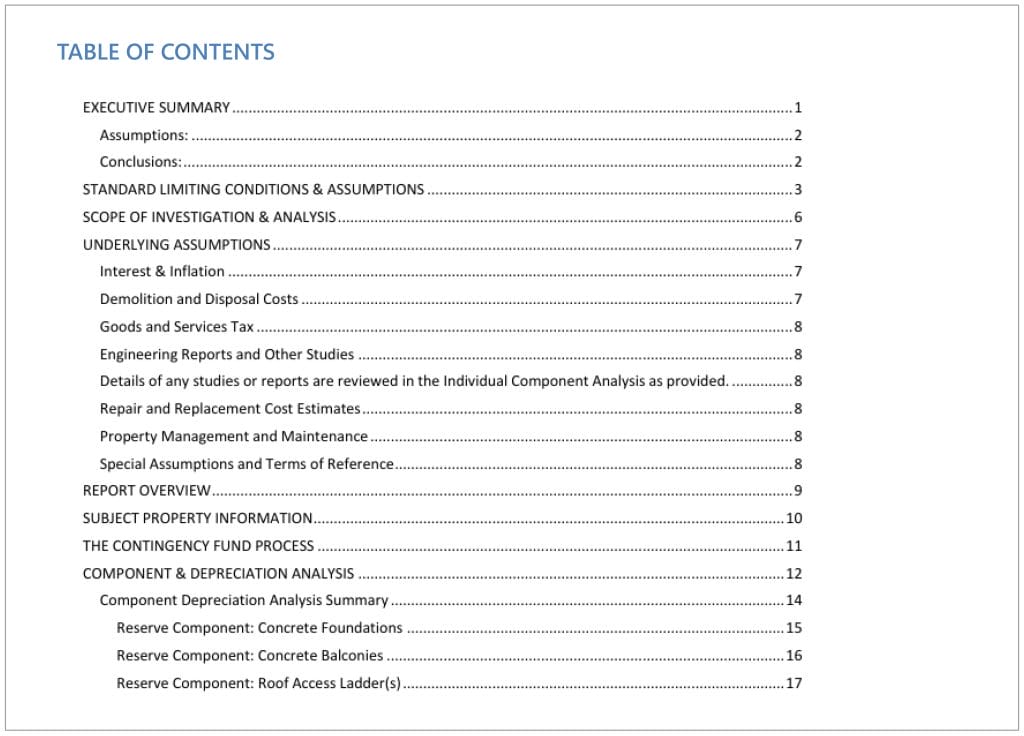
Core Sections of a Depreciation Report
Component Inventory
This is the foundation of the report, and it lists the major property elements you, as a strata, are responsible for maintaining, repairing, and replacing over time.
Most Common Components Included:
- Roof, and roof systems
- Balconies and railings
- Exterior walls and cladding
- Windows and doors
- Building membranes (Including parkades and podium decks)
- Elevators
- Mechanical systems (HVAC)
- Plumbing systems and irrigation
Be sure to review the list of components to ensure it is complete and accurately reflects your actual building. If major elements are missing or grouped too broadly, it may affect future planning.
Condition Assessment
This section of the report will describe the observed and assessed condition of each component of the building. In most cases, these assessments are based on visual inspections and recent records. (Not a product of detailed and invasive testing)
Treat this assessment as a snapshot of the components listed in the report and their high-level condition. While it can provide helpful context, it likely will not capture hidden issues such as undiscovered deterioration inside walls, deep water ingress under membranes, etc.
Useful Life vs. Remaining Life
This section can be one of the most important, yet often most misunderstood parts of the document.
- Useful Life: This is the typical lifespan of any component listed under normal working conditions and situations.
- Remaining Life: Based on the consultant’s experience and observations, this is an estimate of how much time remains until the component should require repair or replacement if necessary.
Use these timelines as planning guidance, but not fixed deadlines. Real-world factors such as weather exposure, maintenance history, and peak usage factors can all shift timelines one way or the other.
Cost Projections
Here you’ll find educated estimates on the cost of repairing or replacing each component listed. Figures are usually presented in current dollar values with a projected increase to reflect inflation and rising construction costs.
Focus on the timing estimates or the life left of major components to help set expectations, and more accurately plan where money will likely need to be spent instead of exact quotes. These figures are planning tools, not actual working quotes.
Funding Models
Most depreciation reports include different funding contribution scenarios, showing how different funding models will affect financial readiness in the future.
You might see:
- Minimum contribution suggestions
- Gradual increases
- More proactive funding approaches
Use this section for long-term financial sustainability. It will help your strata understand how fund contribution decisions today can impact the likelihood of having to make special concessions later.
Where to spend the closest attention
For most stratas, the most valuable of these sections will be:
- Remaining life timing estimates for major components
- High-cost repairs or replacements expected in the next 5-15 years
- Different funding model comparisons
These will all directly inform more accurate maintenance planning, budgeting, and communication with unit owners.
Where to be cautious
Keep in mind what your depreciation report is not:
- Not a construction timeline or schedule
- Not a thorough or detailed scope of work
- Not an exact cost estimate
It’s a planning framework that helps you anticipate building lifecycle costs and prepare for them. This information is best paired with inspections, expert advice, and real-time decision-making as projects or issues present themselves.
Common misinterpretations can lead to costly mistakes
Your depreciation report is an incredibly useful planning tool when interpreted correctly. Some of the more common misunderstandings can lead to delayed maintenance, emergency repairs (when they shouldn’t have been an emergency), and budgeting gaps. Below are a few understandings strata councils should keep in mind:
- Don’t treat timelines as fixed
It’s easy to look at the line item that says “roof replacement in 8-10 years” and treat it as a firm deadline. Remember that the estimate was only made at the time of the inspection. A few years of unseasonably hot or cold weather after the inspection can dramatically shift those timelines.
- Don’t assume cost estimates are totally accurate
Cost projections in the depreciation report are high-level, meant to help with financial planning, not the final project budget. They can’t accurately account for hidden damage, permit costs, engineering fees, access challenges, etc.
- Don’t delay maintenance because replacement is “years away.”
One of the more common (and expensive) mistakes is deferring repairs because a major replacement is projected further down the road.
For example, if a membrane is expected to last another 10 years, that doesn’t mean suggestions of a leak should be ignored today. Small issues left unattended can accelerate deterioration, shorten the lifespan of components, and increase costs significantly.
What to expect in the executive summary?
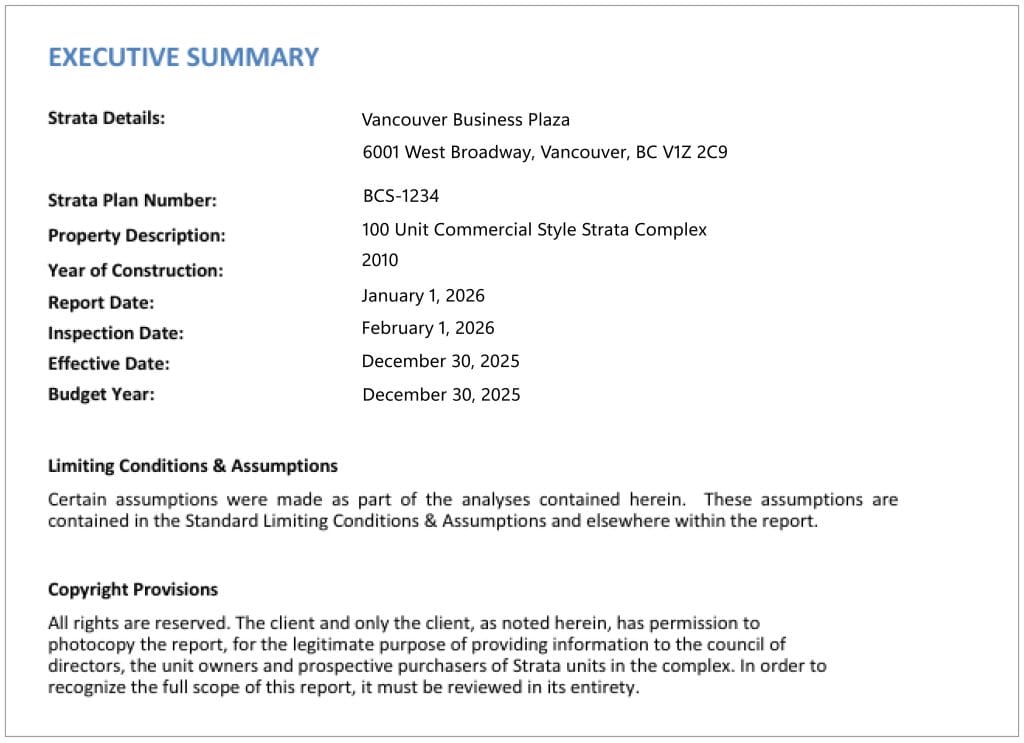
Where Depreciation Reports Can Fall Short
It’s important to remember that depreciation reports have their limits. Doing so can help strata councils avoid relying on the reports for decisions they weren’t designed to support.
Because most depreciation reports are based on visual reviews, maintenance checks, and industry assumptions, they don’t typically include detailed or thorough testing, deep diagnostic work, or analysis of past repairs and workmanship. This all means that two buildings with similar “remaining life” estimates could face very different real-world outcomes or risks.
So, the beauty and limits of depreciation reports are that they help you see what’s coming financially, but they don’t tell you how individual building components are truly performing today.
The right way to use your Depreciation Report
Used properly, a depreciation report becomes a powerful planning tool, helping councils understand long-term financial pictures, spot decision-making windows for individual components, prepare for major repairs before they become urgent, and plan reserve fund contributions with more confidence.
The key is to treat the report as a starting point, and not a final answer.
As major repair timelines get closer, assumptions should be clarified with detailed inspections and condition assessments. And after any major capital project, the depreciation report should be revisited so future planning reflects what’s already been completed. This keeps the report a living document instead of something that just sits on the shelf.
From Projection to Reality: Condition Assessments
The most effective strata planning happens when your depreciation reports are paired with real-world knowledge of your building’s conditions.
As different components begin to approach the later stages of their lifespan, targeted inspections and assessments can:
- Clarify the actual condition or state of repair versus the assumed condition
- Improve cost planning accuracy
- Conform timelines
- Reduce the likelihood of surprise repairs or costs
This added layer of information gives councils more confidence when communicating with owners about upcoming work and funding, and helps turn a long-term financial model into a grounded decision-making tool.
Strong Stratas: How the most prepared councils use their depreciation report.
Having a depreciation report commissioned every few years is one thing; actively using it to prepare for the future takes this valuable tool to the next level.
Here are some of the best practices we’ve observed:
- An annual review of the latest depreciation report (Not just a renewal)
- Tracking completed repairs against the original assumptions
- Updating future component planning after major projects or repairs
- Connecting long-term projections with day-to-day maintenance strategies
- Actively updating reports after major work on components
- Ensuring current condition data informs planning decisions
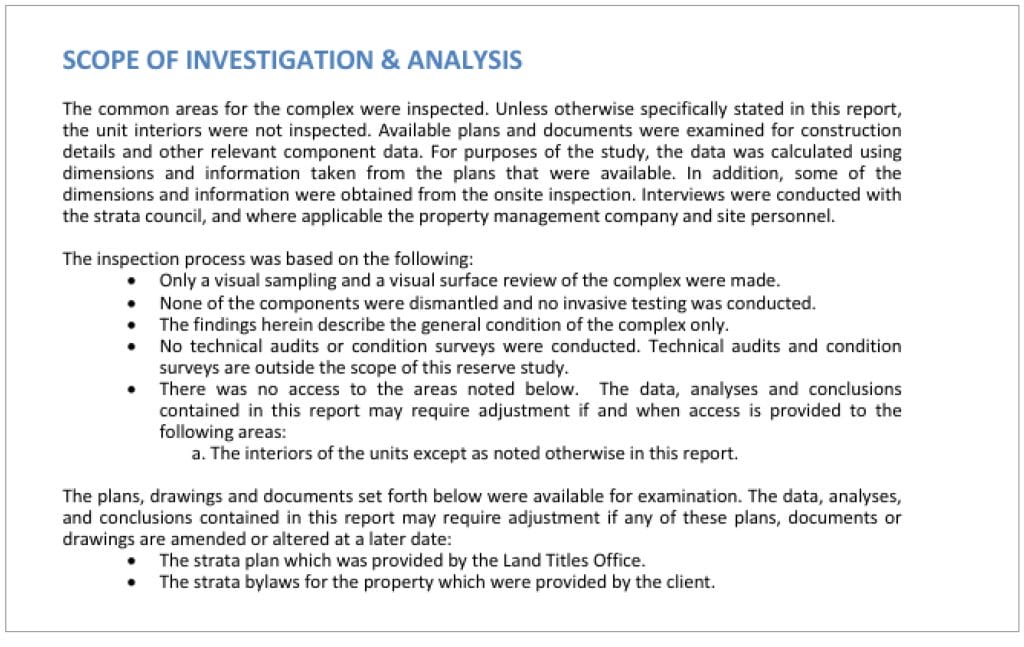
What to expect in the scope of investigation and analysis?
A Quick Reality Check
As a strata, it’s important to step back and ask a few key questions before making major repairs or funding decisions.
Key factors in decision-making:
- Do we fully understand what the depreciation report tells us? (And just as important – what it doesn’t.)
- Does the report reflect repairs that have been recently or already completed?
- Which building components are approaching decision-making windows?
- Do we need updated condition insights before planning next steps?
A thoughtfully used depreciation report supports stronger capital planning, better timing, and more cohesive and deliberate decision-making over time. With reduced uncertainty and fewer surprises, conversations in the council usually become more constructive and collaborative.
And that is a very good thing.
Setting yourselves up for success
When your depreciation report is understood and used properly, it helps councils move from reactive thinking and spending to steady, long-term preparations and planning. This allows you to schedule repairs and maintenance before issues become urgent, align on priorities, and enjoy more confidence in the path ahead.
Your depreciation report may not provide all the answers, but it does give everyone involved a common reference point for making thoughtful, informed decisions together.
Wondering how your depreciation report aligns with your building’s actual condition?
If your council is reviewing a depreciation report, preparing for a major capital project, or simply trying to understand what all the numbers really mean, you don’t have to navigate it alone.
At WCP Building Renewal, we work with strata councils, owners, and property managers to clarify scope, prioritize timing, and bridge the gap between high-level projections and on-the-ground building performance. From detailed condition assessments and targeted investigations to capital repair planning, we help turn projections into informed action.
Let’s start with a practical conversation. We have the experience and industry expertise to walk your council through your depreciation report, assess and clarify the information it holds, and help you plan the next steps with confidence and clarity.
Get in touch
To learn more about how we support strata councils with depreciation report reviews, building condition insight,s and capital planning, contact us at [email protected] or call us at 604-420-5552.
Plan ahead with confidence, clarity, and practical guidance tailored to your building’s needs. Reach out today for a free, no-obligation consultation.